Showing posts with label Pulp 101. Show all posts

Monday, September 15, 2014

Pulp 101 - The Fantasy of Norvell W. Page

Page’s 1st-Century Adventures

by William Lampkin
This article was originally published in The Pulpster (#16) in 2007 and subsequently posted on ThePulp.net, all rights are those of the author and/or his publisher and is presented here for educational purposes only.

Norvell W. Page and The Spider are almost synonymous. Mention one, and for most pulp fans, the other’s name pops to mind. And it’s certainly understandable. Of the 118 published Spider adventures, Page penned (under the house name of Grant Stockbridge) the bulk from 1933 through 1943, a total of 93 novels.
When Page wasn’t working on a Spider novel, he was busily banging out stories for Spicy Detective,Detective TalesDime Detective MagazineTerror TalesHorror Stories and an occasional Western pulp.
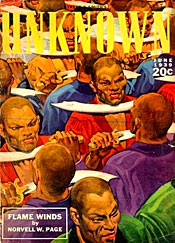
"Unknown" (June 1939) featured Page's first Prester John story.
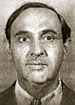
Norvell W. Page
Norvell W. Page
But in 1939, in the middle of The Spider and other detective yarns, Page holstered the automatics and picked up a sword. In the June and November issues of Street & Smith’s Unknown, Page journeyed back nearly 2,000 years for two novels: “Flame Winds” and “Sons of the Bear God.”
Both sword-and-sorcery adventures starred a tall, bronze-skinned, gray-eyed warrior with flaming red hair and beard. He was known variously in the yarn as Wan Tengri, John of the Wind-Devils, Hurricane John and his birthname, Amlairic. But the legends of history knew him as Prester John.
The Prester John story was widely known through the ages. He was a mythical Christian king of a far-away land, which no one was ever certain where. French scholar C.F. Volney explains in his 1791 work,The Ruins, or Meditation on the Revolutions of Empires: And the Law of Nature, that the person “whom we find mentioned in our old books of travels, by the name of Prester John, (gets his name) from a corruption of the Persian word ‘Djehan,’ which signifies the world, to which has been prefixed the French word ‘prestre’ or ‘pretre,’ priest.” Therefore, Prester John means priest of the world. Volney, though, names the “Delai-La-Ma, or immense high priest of La,” as the actual Prester John.
Others aren’t so specific and placed the mythical kingdom of Prester John in Africa, the Middle East or the Far East, and in periods throughout the Dark Ages.
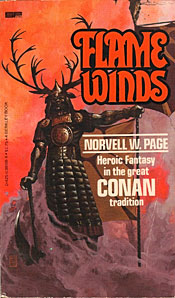
“Flame Winds” was reprinted in paperback form by Berkley in 1978.
The ever-inventive Page twisted these well-known tales to better suit his readers. He rips Prester John from that era, casts him anew in the 1st Century and rethinks his origin. No longer is he Priest John, but Hurricane John. Page explains in the preface to “Flame Winds” that in actuality, “prester” derives from the Greek word (by way of Latin) for the fierce storms of the Mediterranean Sea. His fierce ways in the arena when he was a gladiator in Alexandria earned him the nickname Prester John, or “Hurricane” John.
Page says that the legend grew from Prester John’s exploits in the 1st Century and was widely known by the 12th Century, when it was heard again by the Crusaders, who believed that Prester John was a contemporary of theirs and would assist them by attacking the Persian Empire from the East while they invaded from the West. But by then, his bones were dust.
Forced to flee – er – travel east “for his health,” this First-Century Prester John seeks what all good sword-wielding warriors do: battles, women, kingdoms to rule and riches to plunder.
But Prester John also seeks followers for “Christos,” Page’s odd take on the Christian aspects of the Prester John legend. John is a convert to a “new God called ‘Christos’ ” and wears around his neck a piece of “the True Cross” as a talisman. In Page’s first adventure, John vows to bring “a hundred thousand to bow before thee, Christos” and “they shall believe, as I believe, no matter what throats must be slit.” It’s not the religion of Christ, but more one taken from the Crusades (which, in Page’s stories, would occur centuries later).
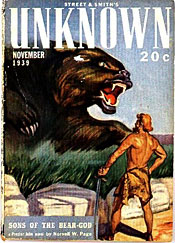
"Unknown" (November 1939) featured "Sons of the Bear Gods," Page's second Prester John story.
“Flame Winds,” which appeared as the cover story in the June 1939 number of Unknown, finds Prester John north of Mongolia near Lake Baikul. He is sneaking into the walled city of Turgohl, which is ruled by seven wizards. Seeking riches, he instead finds himself battling to bring down the wizards and restore an enchanted princess to the throne (oh, and with that, gain riches). He’s joined by a monkey–faced, treacherous thief named Bourtai.
(Midway through the story, Prester John earns the honorific of “Thou art the man!” by the people of Turgohl. Humorously to modern ears, that translates into “You da man!” which popped into my mind every time I read the phrase.)
Needless to say, Prester John manages to defeat the wizards and, in typical Page fashion, slaughters thousands, using a blast-furnace-like devil wind. But the victory is bittersweet, and the story ends with Prester John and his reluctant travelling companion Bourtai sailing in a rickety boat across the Baikul Sea.
“Sons of the Bear God,” originally published as the cover story in the November 1939 number ofUnknown, opens with the overly boastful Prester John and monkey-faced Bourtai fleeing John’s former friends, the Mongols, through the reed sea of Buryat. He is captured by warriors of a red-headed race similar to John’s. The red-headed warriors are slaves to a dwarf-like race of people called the Tinsunchi, the grandsons of the Heaven-Bear. Again, mass slaughter eventually ensues and Prester John comes out ahead – for a while.
(Incidentally, in both books, Page keeps mentioning the black sand desert of Kara-Korum. But Kara-Korum is a mountain range bordering China, Pakistan and India, rather than a desert. The black sand desert he refers to is actually the similarly named Karakum Desert, which is in Central Asia, in present day Turkmenistan.)
Marvel Comics adapted Page's Prester John stories as Conan adventures in 1974 and 1980.
The two novels mesh one into the other rather well, with many references in the second story back to the first. But the second adventure is about 10 percent longer than the first, and could have easily ended a full chapter before it actually does. Blame it on payment via word count.
Neither story is outstanding, but both are typical fantasy adventure. In fact, the stories were so boilerplate that writer Roy Thomas adapted them for Marvel Comics’ Conan the Barbariancomic books. A version of “Flame Winds” appeared in three issues (32-34, November 1973–January 1974), and one of “Sons of the Bear God” ran for four issues (109-112, April–July 1980). Prester John morphs into Conan, with Bourtai as himself in the first story, but as Erfu the Stygian in the second adaptation. (Incidentally, Thomas changes the name of the city of Turgohl in “Flame Winds” to Wan Tengri, the Mongol name that Page uses interchangeably for Prester John.)
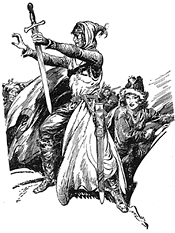
Prester John in "The Singing Sands of Prester John," by H. Bedford-Jones.
Prester John was not a regular character in the pulps, but curiously he did appear elsewhere in 1939. “The Singing Sands of Prester John,” by H. Bedford-Jones, addresses the legend as part of Bedford-Jones’ “Trumpets from Oblivion” series in the February issue of Blue Book Magazine. Though Prester John never actually appears alive in the story, he’s referred to and appears in the story’s main illustration (at right).
Page’s two Prester John novels were reprinted by Berkley Books in 1969, then again in 1978 and ’79. Riding on the popularity of Robert E. Howard’s barbarian, the books were promoted as “heroic fantasy in the great Conan tradition.”
These reprints often turn up in used bookstores or you can track down the original Unknown magazines, so anyone wishing to experience the epic fantasy mayhem of Norvell Page should have little trouble. Just gird thyself for an abundance of florid prose.

Wednesday, August 20, 2014

Heroes of Pulp (Part 1) - The Shadow

Heroes of Pulp - Part 1 - The Shadow
The early pulps were often defined and collected based on similar themes and genres. Short stories by any number of authors could be found in a magazine because they shared some common element. But during the Depression, as sales in the pulps began to dwindle, there was a growing interest in specific characters. Readers of comic books, a growing trend at the time, wanted stories connected by a single hero. Thus the first character pulps were born.

One of the first of these character magazines was the immensely popular The Shadow. In 1930, Street & Smith were broadcasting a very popular radio program called Detective Story Hour. This was a dramatized version of stories found in their Detective Story Magazine, one of the most well read detective pulps in history. The narrator of this program was a mysterious voice known only as The Shadow. Due to fans enjoyment of the character, the publisher decided to attempt to make stories based around him. Editor Walter B. Gibson was hired to devise the novels that would be featured in a new magazine. With little background or character developed for the radio narrator, Gibson had free reign to create a memorable and enjoyable character.
Debuting in 1931 as a quarterly, The Shadow's first tale, "The Living Shadow", was an instant success. The later sequels would cement The Shadow as one of the most popular and influential pulp characters of all time. In fact, much of what we think of as "pulp" in style, is typified in the Shadow stories. Rather than rely on gritty realistic crime stories, like those being published by Black Mask, Gibson took his adventure story influences and applied them to mystery, creating one of the first crime-fighting superheroes.
The unprecedented success of the magazine drove publishers to push it from being a quarterly print to monthly, and then eventually bi-weekly by 1932. Because writing a novel-length story every two weeks would kill any writer, the publishers assumed that Gibson would need the help of ghost writers. But Gibson was able to keep up with the new pace of printing for the next decade. Though the stories were purely written by Gibson, he made good use of brainstorming sessions with Street&Smith executives and editors to help keep the ideas flowing.

Friday, July 25, 2014

Pulp 101 - Zeppelin Pulps

The Zeppelin Pulps

The following is an essay by Jess Nevins, writer and expert on the pulps. His essays have appeared in journals as well as the backs of the popular comics by Ed Brubaker and Sean Phillips. This extended, and well researched essay has been reposted from its original form on Nevins' blog, No Fear of the Future. All copyright is that of the author and is merely presented here for informational purposes.
The following is an expanded version of my essay in Incognito #6, the last issue in the wonderful pulp-supers-noir comic by Ed Brubaker and Sean Phillips. Incognito #6 is in stores today (make sure to buy three copies each!) and a shorter version of the following appears there. For space reasons I had to cut some things out, but Ed’s graciously given me permission to repost the original here.

(BTW, this may be the single thing I’m most proud of having written, if only because doing research on the zeppelin pulps and the background to Complete Zeppelin Stories was such a challenge. I’d read Complete Zeppelin Stories, of course, but the context to it, and the information on the other pulps was extremely hard to find. This was a challenge from start to finish, and I’m glad I met it).

Posterity is cruel to popular culture. Successful series, in any medium, find themselves quickly forgotten. Sexton Blake was the second-most imitated character in the world in the 1930s, after Sherlock Holmes, and today Blake is virtually unknown. The radio serial “Fibber McGee and Molly” was famous internationally in the 1930s and 1940s and is now almost forgotten. This was true of the pulps, as well. One of the best examples of the forgotten pulps is the genre of zeppelin pulps and Complete Zeppelin Stories, the most famous zeppelin pulp of them all.

During the late 1920s Frank Armer (1895-1965) was the man behind Ramer Reviews, a publisher of four minor pulps, including Zeppelin Stories, which was best known for Gil Brewer’s lost apes-and-zeppelins classic, “The Gorilla of the Gasbags.” Ramer Reviews failed in late 1929 and Armer became an editor for Harry and Irwin Donenfeld on their “spicy” line of pulps, including Spicy Detective Stories. In 1935, for reasons not known, the Donenfelds and Armer had a falling out, and Armer left the Donenfelds’ Culture Publications.

On February 12, 1935, the U.S. Navy Zeppelin Macon, pride of the Navy’s aerial fleet and hoped-for model for future U.S. military zeppelins, crashed off the coast of California. The Macon disaster, two years before the more famous wreck of the Hindenberg, cast doubt on the viability of zeppelins as military vessels. But the zeppelin boosters within the U.S. Army and Navy were unwilling to let a freak accident spoil their plans for a fleet of armed zeppelins, and sought for a way to redeem the image of the zeppelins in the eyes of the public.

Monday, May 19, 2014

Pulp 101 - The Pulp Magazines Project

The Pulp Magazine Project
So now that we have covered what a pulp magazine is, I am hoping a few of you will want to know where to find them. While new pulps are still being made (something we will cover in posts to come) and collections are easy to find on sites like Amazon or in a few book stores, the real beauty of this medium is when it was made. Because so many magazines were printed before the advent of modern copyright law, most pulps are available in the public domain.
So where do I go to read some of these stories, you might be asking. Well, one of my favorite places to go is the fantastic Pulp Magazine Project. The Pulp Magazines Project is an open-access digital archive dedicated to the study and preservation of pulp magazines. It is a great resource (one I will use for future posts) on the history and cultural importance of the medium. But most impressive is its collections of pdfs and Flipbook archives of these classic magazines.
In the upcoming months I will be showcasing some of the specific stories and magazines that can be found in this public-domain archive. But until then, take some time to look through a few, open up a magazine or two, and you might be pleasantly surprised at what you find.
If you are having trouble deciding, check out this great issue of the mystery magazine Black Mask!

Saturday, April 19, 2014

Pulp 101 - What is Pulp?

What is Pulp?
   "Pulp" is a term thrown around a lot. For some it is a term for low-brow entertainment, for others, it is the stuff floating in your morning orange juice. Well, the word has sort of departed from its roots. That is what this series is all about. Pulp 101 explores and explains the world of pulp fiction. To start, we have to understand what the term even means. Pulp, in regards to writing, and the true origin of what we are talking about here, comes from the material the fiction was written on, and not really the fiction itself. This of course changed over time. But the word 'pulp' was used because during the late nineteenth century, cheap accessible writing was being printed on low-cost wood pulp paper.

   The economy was on the rise, and industrialization was providing the working class with more leisure time. Before the real success of cinema and long before television, the literate masses were flocking to the written word to be entertained. Tastes were beginning to vary with the larger audience and publishers not only needed to find new and exciting fiction for these hungry masses, but a cheap way to print it. Hardback books were quite expensive at the time. The most popular medium were large newspaper like collections of fiction called "story papers" and dime novels, which had gained popularity during the Civil War. A logical progression lead these large format sheets to be printed on a smaller scale, with cheap paper and covers. By 1896, Argosy introduced the world to what would be the very first pulp. The Argosy company claimed to pack "a dollar's worth of reading for ten cents", and the pulp industry was born.
   The size and shape of pulps in the coming decades would change based on reader taste, but mostly on further cost cutting methods. The average pulp magazine measured about 7x10 inches and contained about 128 or 144 pages (though during times like the Great Depression, this page count got as low as 64 pages). Until 1936, publishers used untrimmed sheets and covers that were a bit larger and hung over the edges of the pages. This has lead to many of the magazines being in rather poor shape even by the time they reached shelves (and made finding mint condition copies near impossible for collectors). But it was always a fine line as far as profits went. Publishers often added new titles, to try and bump sales, a risky move with razor thin profit margins. So the number of titles on the shelves were constantly fluctuating as well.

Tuesday, March 18, 2014

Pulp 101 - A New TN Series

Welcome to a new Tentacle News blog series. Pulp 101. Over the last few years, I have had great success and enjoyment working on my Lovecraft 101 series. But lately, I have struggled to find or think of interesting and new things to post on this blog. The recently it hit me.
I have been a long time fan of pulp literature. From the adventure stories of Edgar Rice Burroughs that I grew up on, to the hard-boiled crime fiction I deeply love today. I have always been inspired and obsessed with the pulps. Many people ask me about my reading tastes, and my love of this strange and almost left behind genre. Even readers of my blog ask about the pulps. What were they? Why do you like these simplistic stories of the dark and downtrodden, or the luridly un-politically correct tales of yesteryear. Well it is hard to really summarize all of that in a simple response. So I have gone a few steps further. Like my in-depth study of Lovecraft with my Lovecraft 101 posts, Pulp 101 will be a study of the genre spanning tales of the pulps. But it will be much more than a simple study of a few stories. I seek to feature articles by pulp fans and critics, show off some great stories that can be accessed in the public domain or in electronic formats. I even want to display some of the great art that came out of these works. The pulps have inspired a lot of our literary and popular culture. It can be seen in comics, movies and television. I want to dive into the deep end of studying what made the pulps so special, so controversial, and so addicting.
So watch for this regular feature, along with Lovecraft 101, to get your literary fix of weird fiction and the stories of twentieth century. I look forward to compiling and putting this series together, hopefully as much as any of you enjoy reading it.